

If you are preparing to complete your White Card in Australia, understanding what not to do is just as important as knowing what the course covers. Many learners begin their white card course training without fully realising how easily avoidable mistakes can lead to delays, assessment issues, or additional costs.
By recognising the most common pitfalls early, you give yourself the best chance to complete the training smoothly, learn the essential safety skills, and receive your card without unnecessary stress. This preparedness is crucial, especially since an ASQA review found that 100% of sampled online RTOs had training durations of four hours or less, raising serious quality concerns.
In this guide, we break down the top white card training mistakes people make, along with practical solutions based on industry experience and what trainers see every day. Whether you are joining the construction industry, visiting worksites, or needing the mandatory construction induction training, this guide will help you stay prepared, confident, and compliant.
What White Card Training Involves
Before exploring the most common white card training mistakes, it’s important to understand what the training actually covers. White Card training is the mandatory construction induction training required for anyone who wants to work on a construction site in Australia. It focuses on essential safety principles, hazard identification, legal responsibilities, workplace communication, and what to do in an emergency.
Star Training and Assessing delivers accredited White Card training in Melbourne, following WorkSafe Victoria requirements. The course blends practical examples with safety fundamentals so learners understand how to operate safely on real worksites. This means arriving prepared and avoiding mistakes is essential for a smooth assessment experience.
Top 10 White Card Training Mistakes to Avoid
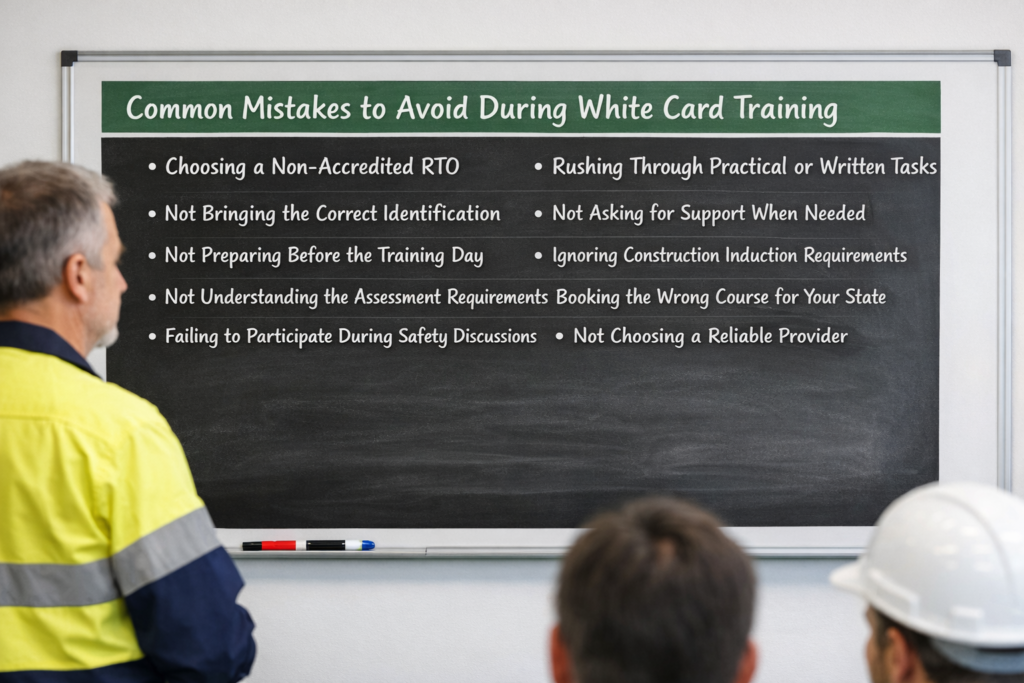
Below are the ten most common mistakes white card learners make, with expanded insights and practical advice to help you avoid them.
1. Choosing a Non-Accredited RTO
Many learners unknowingly book their White Card course with providers that are not fully accredited. This leads to certificates that employers refuse, and delays your work on construction sites. If the training is not delivered by an approved RTO, your White Card will not meet national standards or WorkSafe Victoria’s requirements.
How to avoid it:
- Always check the RTO number before enrolling.
- Confirm the unit code (CPCWHS1001) is included.
- Choose a provider with a proven track record, like Star Training & Assessing.
2. Not Bringing the Correct Identification
Incorrect or missing identification is a very common issue that delays assessments. Many learners arrive without acceptable ID documents, which are required to verify their identity under WorkSafe Victoria rules. Without a proper ID, you cannot complete the course.
How to avoid it:
- Bring original, valid photo ID such as a driver’s licence or a passport.
- Read the pre-course ID instructions carefully.
- Contact the RTO beforehand if unsure about acceptable documents.
3. Not Preparing Before the Training Day
Some learners assume the course is simple and walk in with no preparation. This leads to confusion during the training session, difficulty learning safety concepts, and a lack of confidence during assessments. Preparation helps you understand the structure of the course and what is expected on the day.
How to avoid it:
- Review the pre-course information provided by your training organisation.
- Familiarise yourself with common construction hazards.
- Arrive early and ready to participate actively.
4. Not Understanding the Assessment Requirements
The White Card course includes both written and verbal assessments. Learners who don’t understand how assessments work often rush, misunderstand questions, or provide incomplete responses. Knowing what to expect helps you stay calm and complete the assessment accurately.
How to avoid it:
- Listen carefully when trainers explain the assessment process.
- Read each question slowly and clearly.
- Ask your trainer to rephrase instructions if needed.
5. Failing to Participate During Safety Discussions
The most valuable part of White Card training is learning through group discussion and real-life examples. Staying silent or disengaged means missing critical safety information that could help you on real worksites. Participation improves understanding and helps you succeed during assessments.
How to avoid it:
- Engage with the trainer’s questions.
- Share your experiences if you have any.
- Pay close attention when others discuss safety scenarios.
6. Rushing Through Practical or Written Tasks
Some participants try to finish assessments quickly, which leads to mistakes, incomplete answers, or misinterpreted safety questions. The purpose of training is to ensure you understand essential safety concepts, not to finish first.
How to avoid it:
- Take your time and read each question carefully.
- Focus on understanding the safety message behind the task.
- Check over your work before final submission.

7. Not Asking for Support When Needed
Learners sometimes hesitate to ask questions, especially if English is their second language or if they have limited experience in construction. Trainers are there to help, and asking early ensures you understand key safety topics.
How to avoid it:
- Let your trainer know if you need additional explanations.
- Ask for examples if something is unclear.
- Speak up early rather than waiting until assessment time.
8. Ignoring Construction Induction Requirements
A White Card is more than just a piece of a certificate. It reflects your legal responsibilities under WHS laws. Learners who treat the course as a formality often miss important information about hazard controls, PPE requirements, and incident reporting procedures.
How to avoid it:
- Understand that White Card training is mandatory under WHS law.
- Ask questions about safety obligations on real worksites.
- Take the content seriously as it protects you and others.
9. Booking the Wrong Course for Your State
Not all White Card courses are recognised across Australia, and each state has rules about how the training can be delivered. For example, Victoria does not accept online White Card training, so booking an online course results in wasted time and money. WorkSafe Victoria explicitly states online delivery is not permitted, and completion of an online course will not result in a valid White Card.
How to avoid it:
- Check state requirements before booking.
- In Victoria, white card courses must be completed face-to-face.
- Only choose providers offering training aligned with WorkSafe Victoria requirements.
While Victoria does not allow online courses, white cards issued in other states (if valid) are typically recognised in Victoria, because White cards are recognised Australia-wide. However, the requirements to obtain that card vary by state (i.e., some other states allow limited online delivery for their residents).
10. Not Choosing a Reliable Provider
Choosing a training provider based only on price often leads to poor-quality training, rushed sessions, unclear explanations, or issues obtaining your White Card. A reputable provider ensures proper assessment, clear safety instruction, and real support.
How to avoid it:
- Choose accredited RTOs with strong reputations.
- Read reviews and course details.
- Select a provider like Star Training that delivers high-quality training with clear guidance.